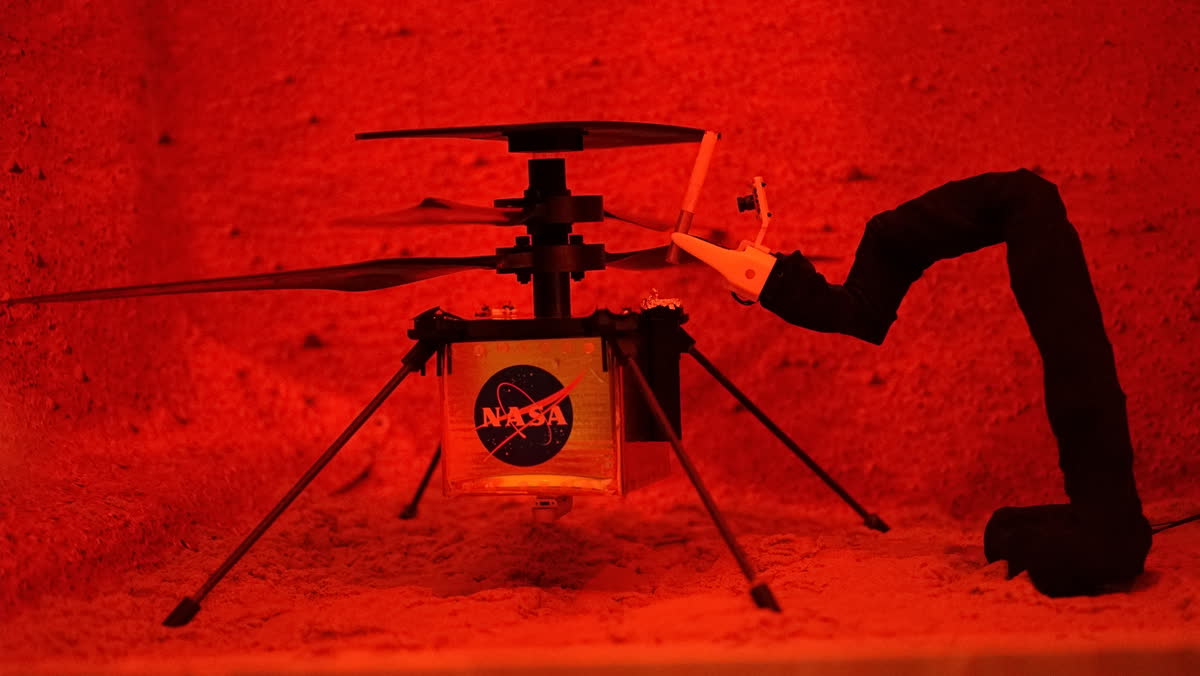
 Task 1
Test-tube transfer
Pick up the test tube and place it in the holder on the helicopter.
LM-EELS
One policy can now fold laundry, wash dishes and assemble parts. A Mars rover still carries a dedicated mechanism for each thing it does. We ask whether the first idea can be taken to other planets.
Sustained work on the Moon and Mars will need robots that can deploy, inspect, maintain and do science, under tight limits on size, weight and power and on terrain most Earth robots cannot cross.
Our proposal is general-purpose space exploration: pair generalist robot policies with one versatile, mission-relevant body, instead of building a new specialist for each job.
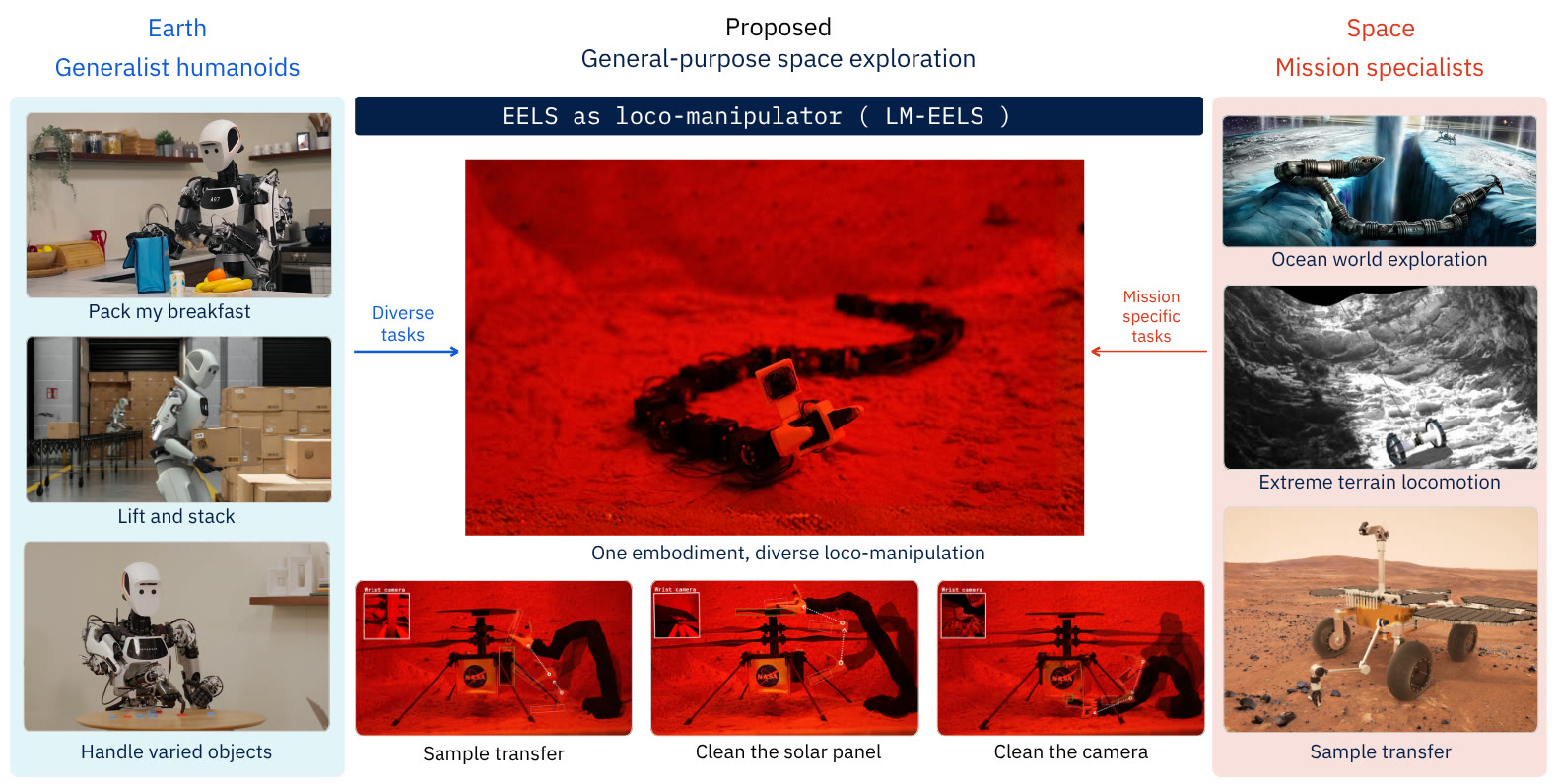
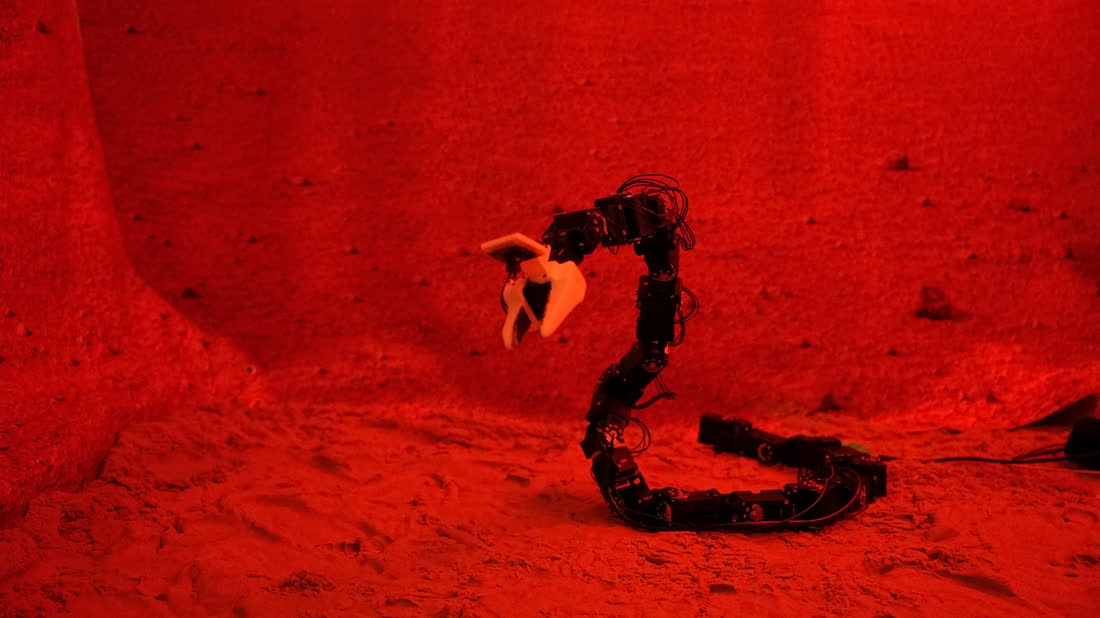
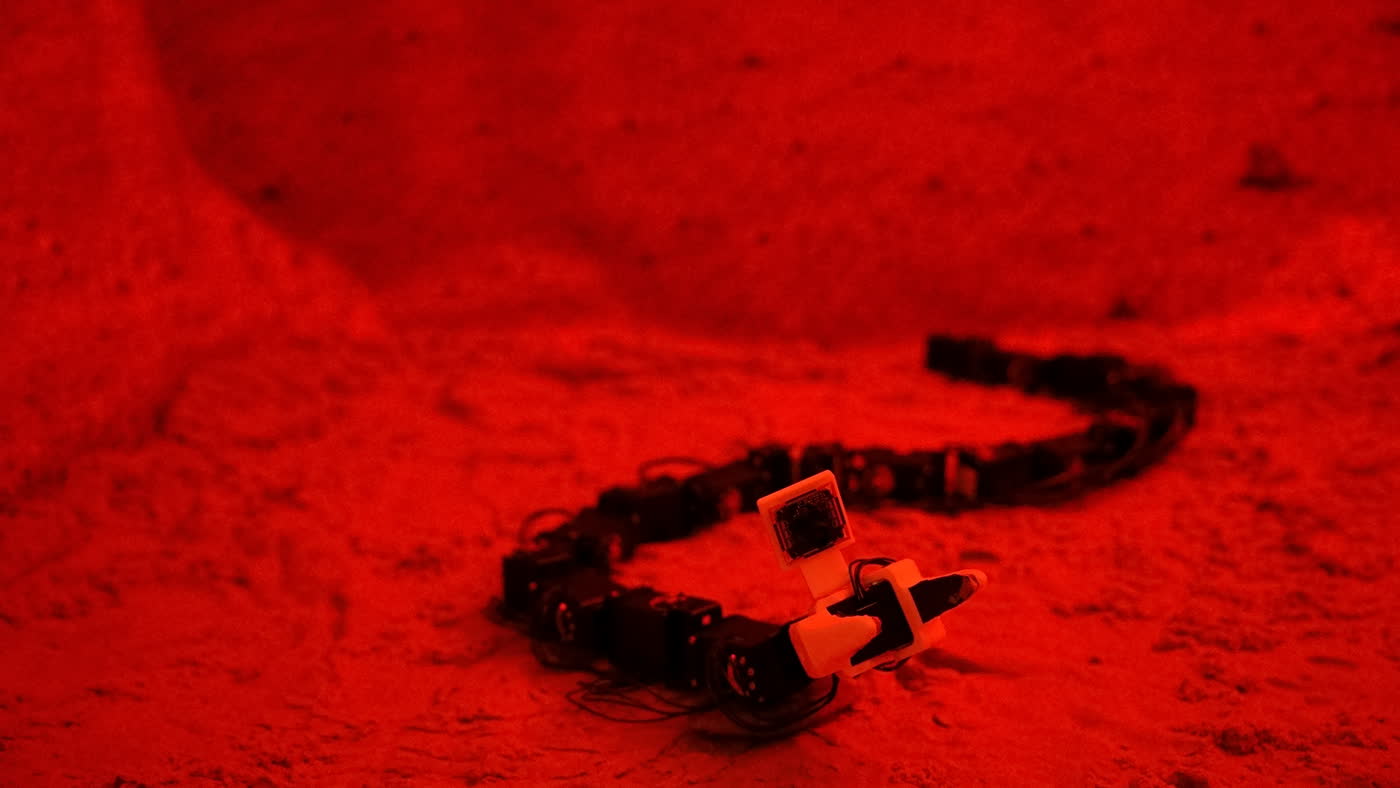
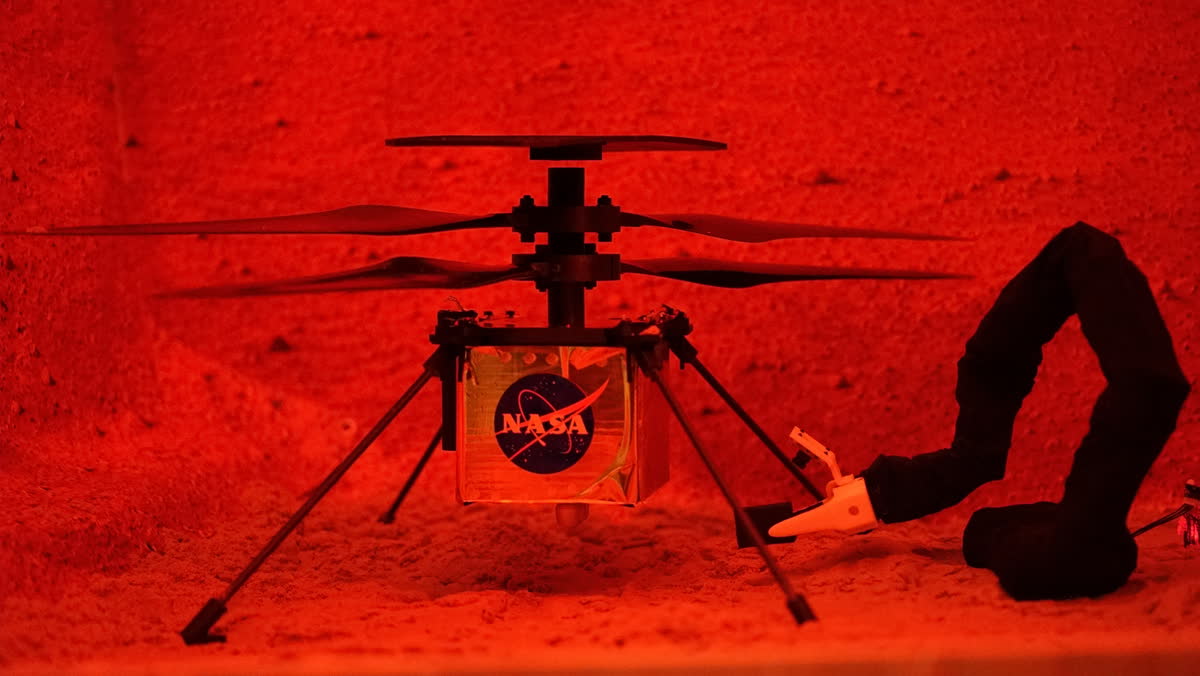
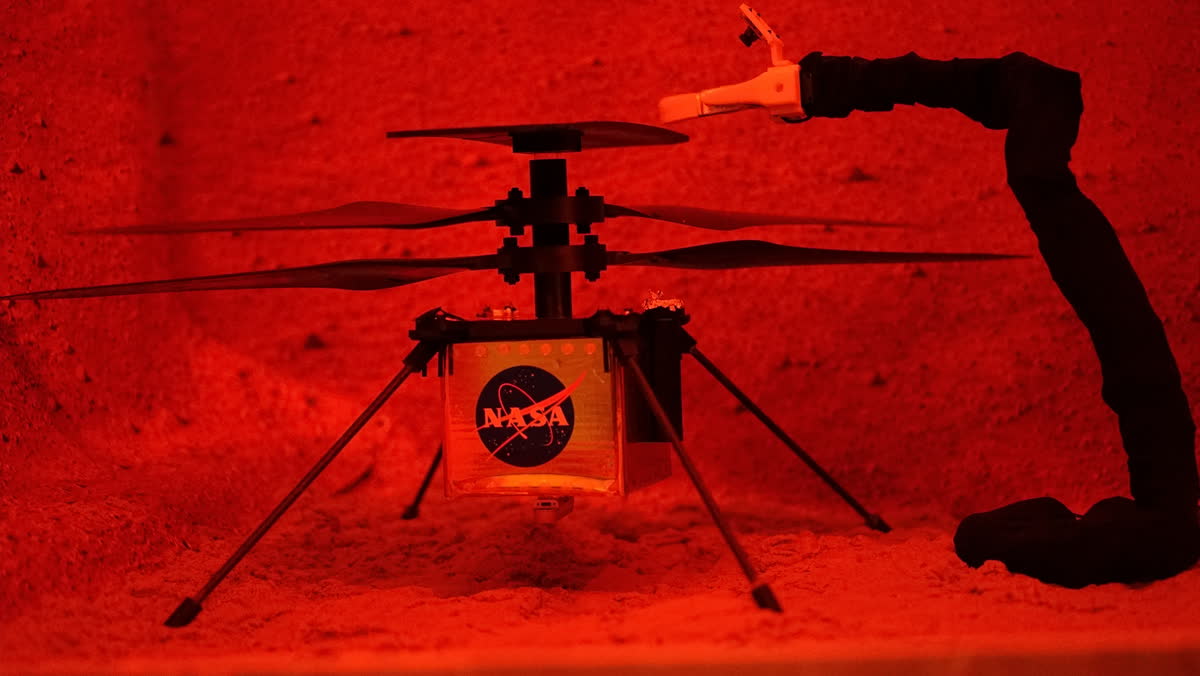
LM-EELS extends NASA JPL’s EELS, an extreme-terrain snake robot, with a head-mounted camera and a gripper. It reconfigures by moving its joints, with no docking hardware.
To manipulate, the snake rears up: ten joints near the tail hold still and form a base, and nine joints toward the head position the gripper. To travel, it uses serpentine gaits, then transitions slowly back into the supported posture.
The actuators are off-the-shelf so that other groups can rebuild it.
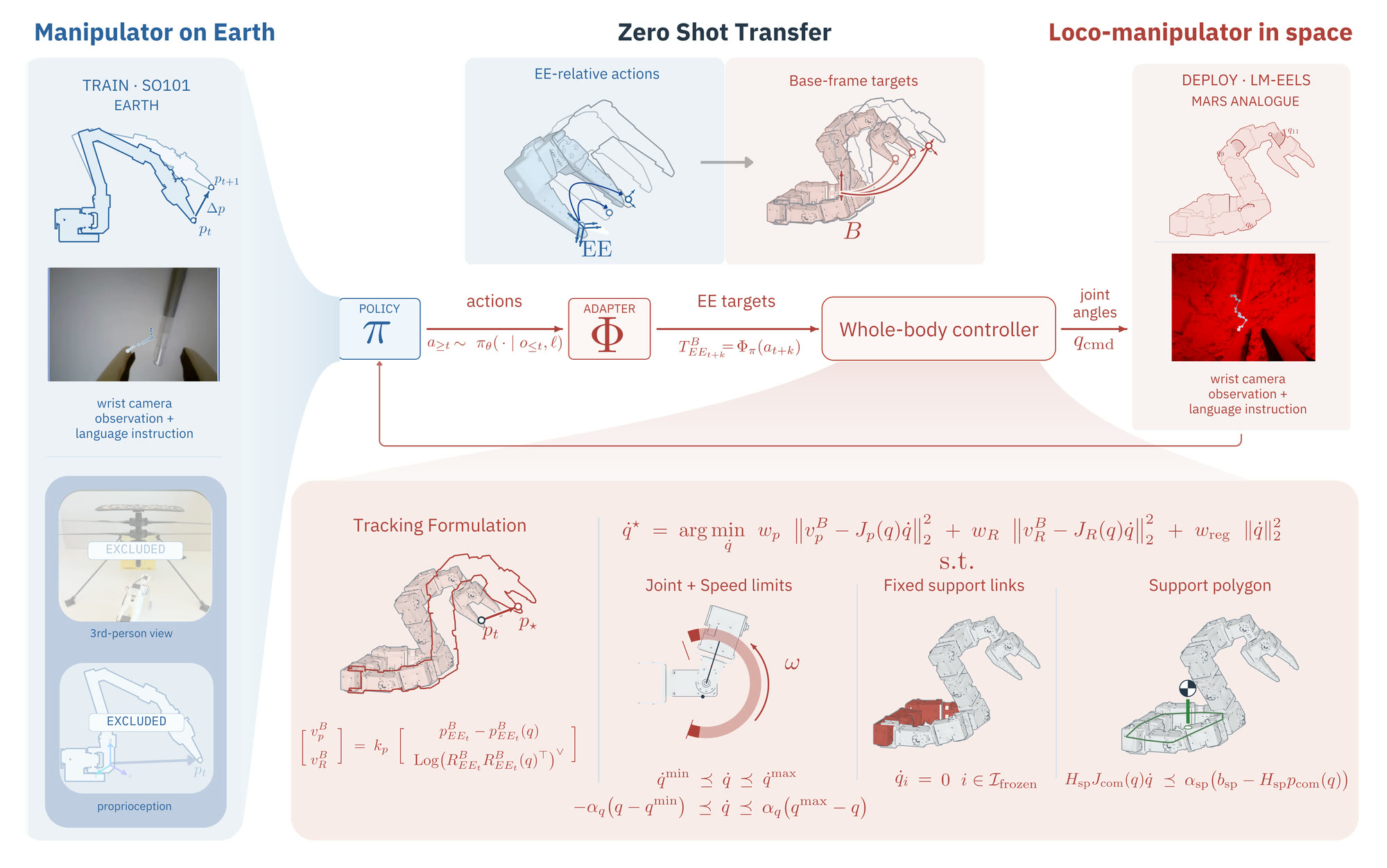
Policies written for ordinary arms cannot drive a snake: the shape, the camera and the action space are all different. We bridge that gap at the interface, not in training.
Every policy sees the same thing on both robots, a single egocentric camera image and a language instruction, with no joint state. Every policy answers in task space, with a pose for the gripper.
A small adapter per policy turns that answer into a common end-effector target. A constrained whole-body controller then realises it on the snake, keeping the base joints frozen and the centre of mass over its support.
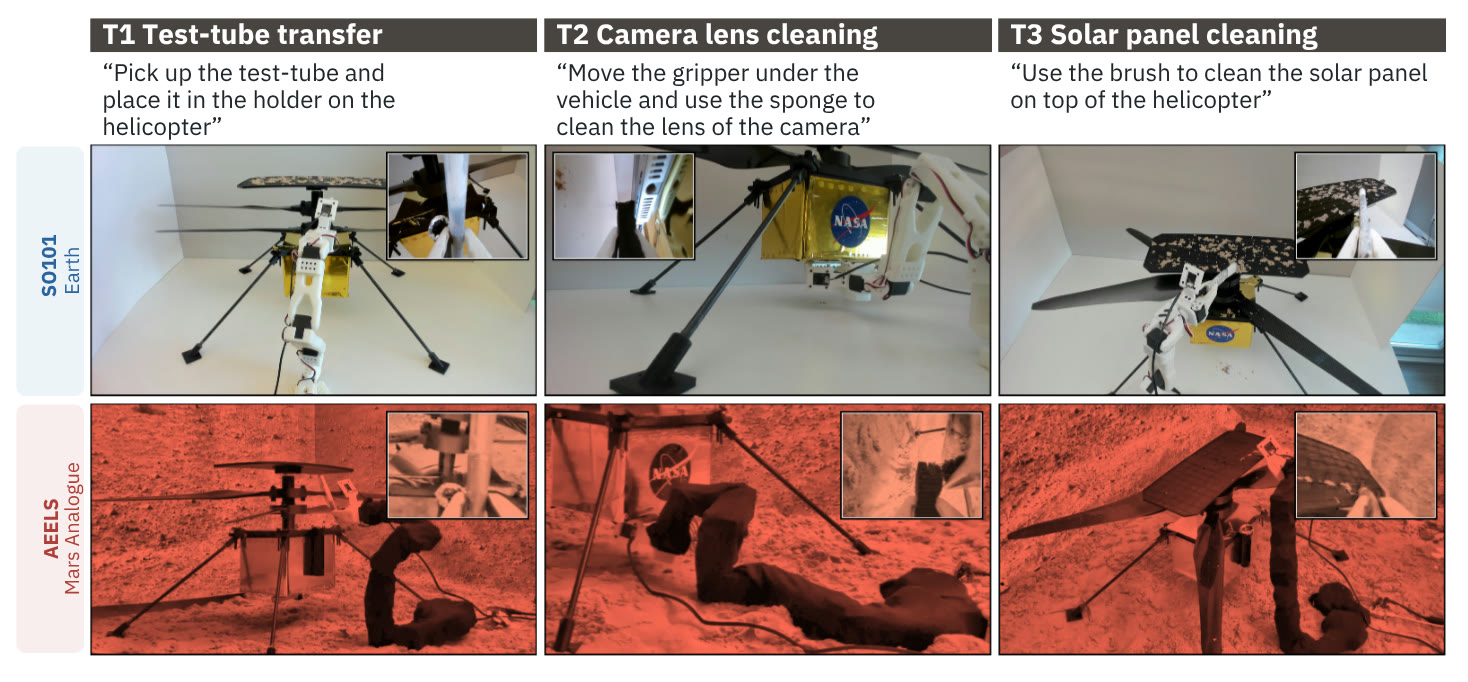
 Task 1
Pick up the test tube and place it in the holder on the helicopter.
 Task 2
Move the gripper under the vehicle and use the sponge to clean the lens of the camera.
 Task 3
Use the brush to clean the solar panel on top of the helicopter.
Reasons about the scene and the instruction. Adapted with in-context human feedback: episode histories stay in context and a person adds written feedback after each one.
Maps images and language straight to actions. Fine-tuned only on teleoperated demonstrations from the SO-101 on Earth.
Learns how actions change the visual world from video. Fine-tuned on the same SO-101 demonstrations.
Out of the box, none of the three completed any of these tasks, even on the arm on Earth. Adapting them helps, but reliable completion stays limited before the robot or the setting changes.
The adapted policies execute task stages on the snake with no snake training. Overall performance drops, yet on solar panel cleaning the fine-tuned policies made more progress on the snake than on the arm.
With the same robot and checkpoints, moving into the Mars-analogue yard lowers progress again. Still, every policy completes the first stage of every task in some trials, and some runs finish the whole task.
The point is not only to make policies run on new robots. It is to turn behaviours that transfer into capabilities a mission can depend on.
We check the transfer stack on its own, by teleoperating the snake through the same interface and replaying recorded arm trajectories on it, so that a failed run can be traced to the policy and not to the controller.
Full numbers are in the paper and will be posted here once it is public.
The stages a policy goes through before it runs on the snake. Pick one to watch it.
General-purpose space exploration needs progress on all three axes at once: tasks, embodiments and environments.
(Submitted to RSS 2027) A full project site will replace this page. Back to Kartik’s site