Robot learning
Adapting generalist policies and moving them across embodiments
- VLA fine-tuning
- World-action models
- Cross-embodiment transfer
- VLM policies
- GR00T N1.7
- Cosmos 3 Edge
- GPT-6 Astra
- MolmoAct 2
- Teleoperation data
- DAgger
- LeRobot
- PyTorch
A few of the robots I’ve had my hands on.

Robotics engineer.
I’ve been building robots since 2015, from a kid-sized humanoid to the software on Toyota’s battery electric vehicles. These days I work on robot learning.
Production autonomy by day.
Robot learning by night.
I work on robot learning: getting generalist policies to do real work on real robots, and building the evaluation that shows whether they can. Four years of shipping autonomy software at Woven by Toyota taught me what that takes.
Adapting generalist policies and moving them across embodiments
Software that ships on vehicles and has to keep working there
Data pipelines and release gates, from CI to hardware
After hours, since 2025.
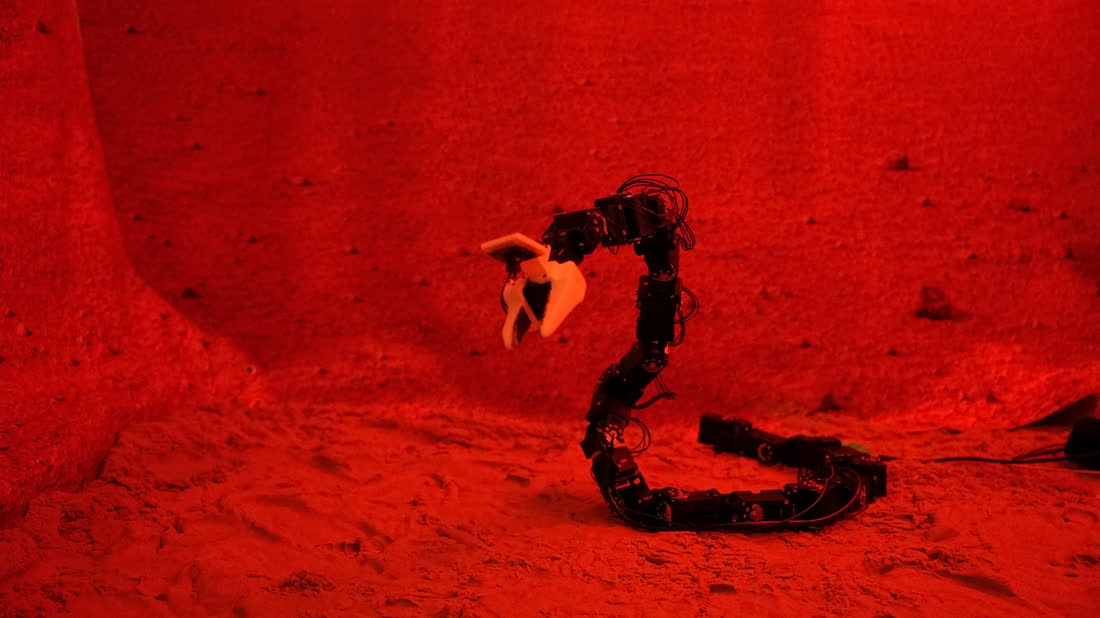
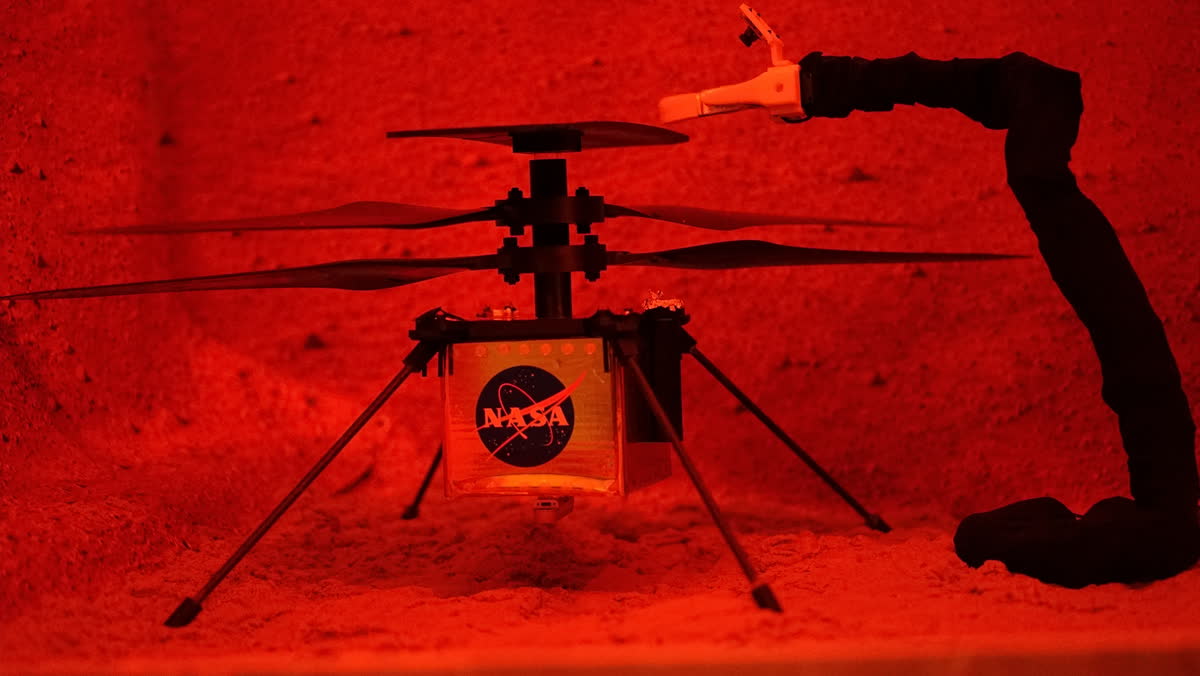 LM-EELS
Towards general-purpose space exploration with a snake robot
Robots on Earth are starting to act like generalists. Robots in space are still specialists, each built around one mission. This work asks whether the same generalist policies can run a robot made for other planets.
We pair them with LM-EELS, a snake that moves, braces and manipulates with one body, and measure what survives the move from an arm on Earth to a snake in a Mars yard.
Open the folderRelease validation. Co-designed the data pipeline that gates the production localization stack. Fleet drives become curated scenario datasets with ground truth, scored pass or fail per scenario. It is also the data-loading core for the next generation of localization models on Toyota’s battery-electric vehicles.
On-vehicle map software. Designed and shipped Map Fusion, the node that merges live lane perception with lane-level maps into the planner’s world model, and the map-priors node that turns fragmented map tiles into continuous road context for lane detection.
Fleet data and trajectory optimization. Built the parallel pipeline that turns crowd-sourced fleet sensor data into map-generation inputs. Fused GNSS with SfM odometry in GTSAM for map change detection, with custom factors and GNN-based landmark association. Three patent filings came out of this work.
LiDAR perception. Built 3D object tracking and prediction with occupancy estimation, using statistical filtering, ray tracing and ground-plane segmentation, for the Vella Development Kit used in commercial ADAS applications. Helped automate training and validation of the perception ML pipelines.
Autonomous exploration. Built curiosity-driven exploration for navigation in unknown indoor environments, benchmarked against a proprietary HRI variant.
Artifact localization. Built a camera-LiDAR fusion method to detect and precisely localize artifacts in GPS-denied subterranean environments for the DARPA Subterranean Challenge.
Fielded in the finals. It ran on Team CoSTAR’s robots in the 2021 Challenge finals and is part of NeBula, the team’s published autonomy solution.
Semantic SLAM. Built autonomous object-level data association, where landmarks enter the map as objects rather than low-level features, enabling loop closure over semantic landmarks. Published at ICRA 2021.
Real-time stiffness visualization for surgical robotics. Built the RViz plugin that wraps live stiffness maps onto 3D organ models with projective-geometry texture mapping, rendering stereo augmented views in the surgical space.
Vision for a modular six-legged robot. Monocular LSD-SLAM and LiDAR-based Hector SLAM on a RealSense and a Hokuyo, with person detection and tracking, for a search-and-rescue walker.
Where it started. Perception and image processing for a 20-DoF kid-sized humanoid built for FIRA 2016, later granted a patent in India.
First autonomy and deep-learning work. A TurtleBot and a custom AGV on the ROS navigation stack, and a Siamese network for multi-focal image fusion.
Thirteen builds, three stages.
Pick a card, then open it.
Generalist robot policies, moved from an arm on Earth to a snake robot built for other planets.
LM-EELS is a 20-DoF snake robot in the line of NASA JPL’s EELS that uses one body to move, brace and manipulate. Policies adapted on a low-cost SO-101 arm run on it with no snake training, through a shared wrist-camera view and a whole-body controller.
When the robot gets stuck, let it change its body before anyone trains a new policy.
A reconfigurable explorer built from the same modules can be a quadruped, a snake, a humanoid or two snakes docked together. Today, when one of those hits an obstacle it cannot handle, engineers go back to simulation and iterate.
This work puts an LLM in that loop. Faced with an obstacle it can reason and adapt the current morphology with no new policy, run a software loop through simulation and metrics, or propose a hardware change.
Work in progress. I contribute to it while guiding the juniors at IvLabs, my undergraduate robotics lab, who are building it with me.
A SLAM system that tracks objects, not just points, and uses them to associate data and detect loops.
Built at WPI: semantic object detection feeds object-level data association and real-time semantic mapping, combining deep learning with classical SLAM. Published as “Semantic SLAM with Autonomous Object-Level Data Association” at ICRA 2021.
Predicting where a vehicle goes next from its own track and the traffic around it.
Trajectory prediction on the Argoverse motion-forecasting dataset using an LSTM encoder-decoder and a Social Ways GAN, so each forecast accounts for nearby agents.
Agents that explore because they are curious, not because the reward says so.
Implemented the Intrinsic Curiosity Module and Random Network Distillation for the MineRL navigation challenge at NeurIPS 2019.
A dueling deep Q-network that learns Atari Breakout from pixels.
Trained a dueling DQN agent to play Breakout from raw game frames. Coursework for CS 525, reinforcement learning.
Aligning two point clouds, one nearest neighbor at a time.
An implementation of the Iterative Closest Point algorithm for point-cloud registration, with a live visualization of the clouds converging.
Making a robot arm behave like a spring you can push against.
Implemented impedance control on a KUKA LWR and on the dVRK Master Tool Manipulator for compliant manipulation and force feedback.
Showing a surgeon where tissue is stiff, drawn live on the organ itself.
Built at Carnegie Mellon’s Biorobotics Lab as a Robotics Institute Summer Scholar. I wrote the RViz plugin that wraps a live stiffness map onto a 3D organ model with projective-geometry texture mapping, and renders stereo augmented views in the surgical space.
It became a first-author workshop paper at IROS 2017, and the full surgical system was published at RSS 2018 and ISMR 2018.
Eyes for a six-legged robot built for search and rescue.
The second project of the same summer at the Biorobotics Lab: a vision system for the modular Snake Monster walker. It runs monocular LSD-SLAM and LiDAR-based Hector SLAM on a RealSense and a Hokuyo, with person detection and tracking on top.
A wheelchair that can drive itself when its rider wants it to.
SARA is a Semi-Autonomous Robot Assistant: a powered wheelchair fitted with navigation and vision modules for assisted mobility.
A custom ground robot built to find its way around indoors.
An autonomous ground vehicle for indoor navigation. A Kinect feeds perception and world modelling; global, tactical and local planners turn a goal set in RViz into wheel commands.
A random walk that never hits the walls.
A Gazebo simulation of random-walk exploration: the robot wanders a walled arena and uses its laser scan to steer clear of obstacles.
Eight papers.
Five patents, filed or granted.
Building generalist robots, or autonomy that has to hold up outside the lab? My inbox is open.